Cinder System Architecture
The Cinder Block Storage service provides persistent block storage for OpenStack clouds. A deployment is composed of several cooperating services that share a database and communicate through RPC.
Cinder uses a SQL-based central database that is shared by all Cinder services in the system. Services use the database for durable resource state and use RPC to coordinate work that must be performed by another service.
Components
Below you will find a brief explanation of the different components.
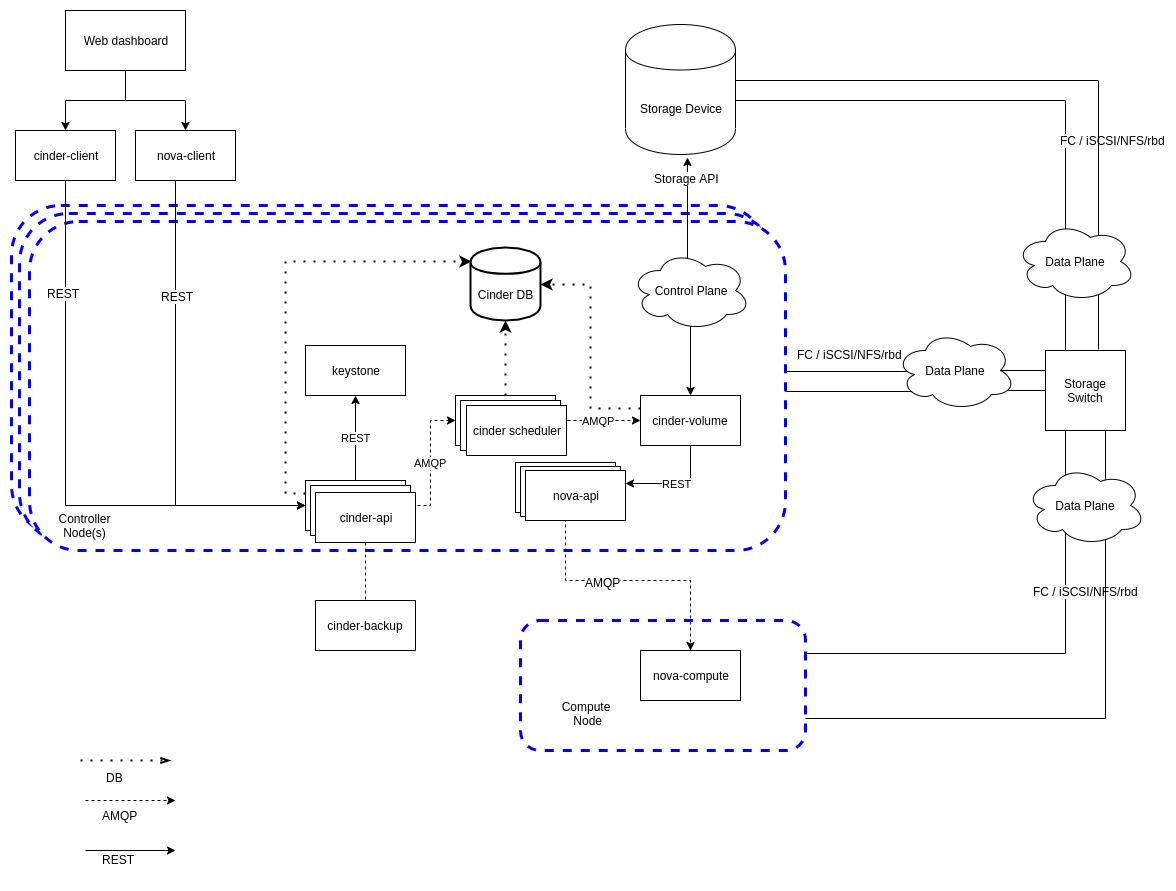
- DB
SQL database for durable resource state. It is used by all Cinder services, though not every relationship is shown in the diagram.
- API
The
cinder-apiservice receives HTTP requests, validates input, applies policy, records initial state, and coordinates work with other Cinder services. API contract changes may require a new microversion; see API Microversions.- Scheduler
The
cinder-schedulerservice selects a suitable backend for operations such as volume creation. It considers backend capabilities, filters, and weighers.- Volume
The
cinder-volumeservice manages volumes on storage backends through Cinder volume drivers. Driver changes should follow Drivers and New Driver Review Checklist.- Backup
The
cinder-backupservice manages volume backups independently from volume drivers. Backup drivers provide access to backup repositories.- Dashboard and clients
Horizon, command-line clients, SDKs, and other services call the Cinder API. These are external to the Cinder service deployment.
- Auth
Authentication and authorization are integrated with Keystone and Cinder policy. Policy definitions live under
cinder/policies/.
Service interaction example
A typical volume creation request crosses several services:
A user or service sends a volume create request to
cinder-api.The API service validates the request, applies policy, and creates an initial database record.
The API service asks
cinder-schedulerto choose a backend.The scheduler evaluates backend state and sends the request to a selected
cinder-volumeservice.The volume service calls the storage backend through the configured driver.
The volume service updates the database with the final volume state.
This example is intentionally simplified. Many operations also involve quotas, conditional database updates, versioned objects, attachment records, or rolling upgrade compatibility constraints. See the focused contributor documents for those topics.
