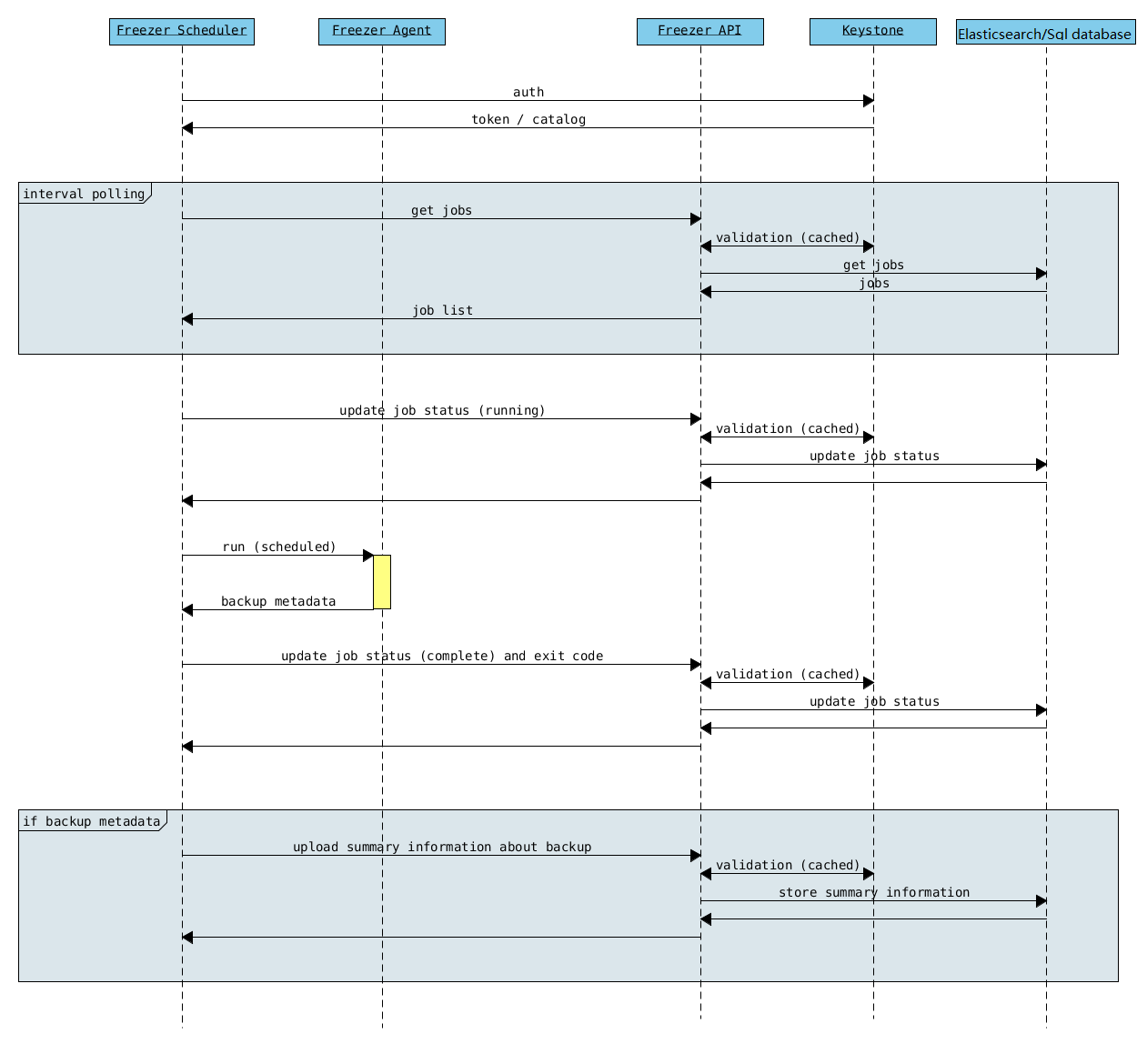
Freezer Overview & Architecture
Freezer is a distributed Backup and Restore as a Service platform designed to deliver high-efficiency, flexible backup strategies across OpenStack clouds and standalone heterogeneous environments.
Architecture & Core Components
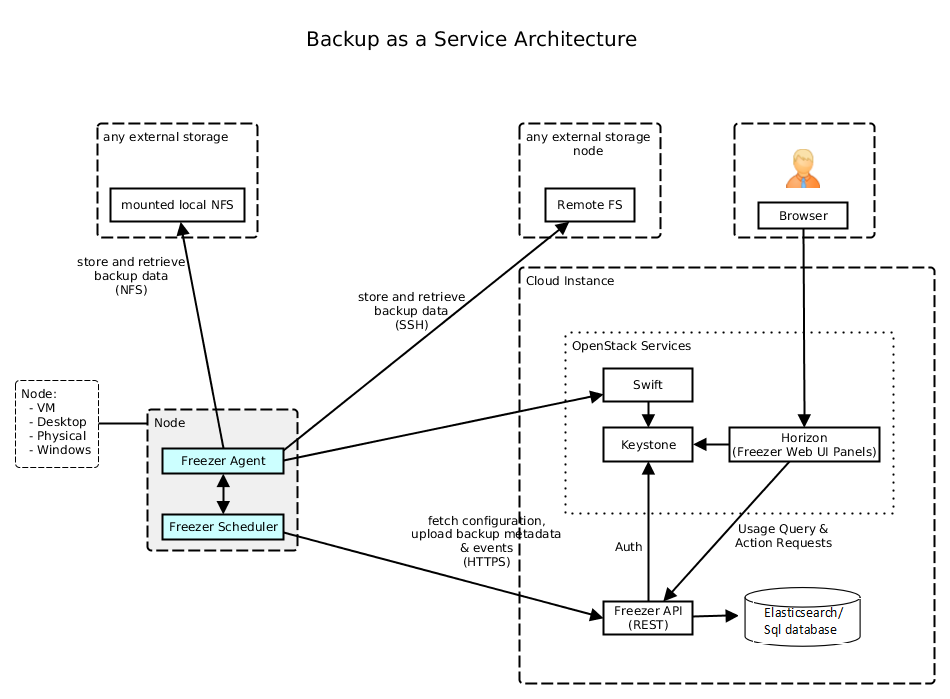
Freezer features a modular architecture that cleanly separates control plane orchestration, metadata storage, and stateless execution workers:
Component |
Description |
|---|---|
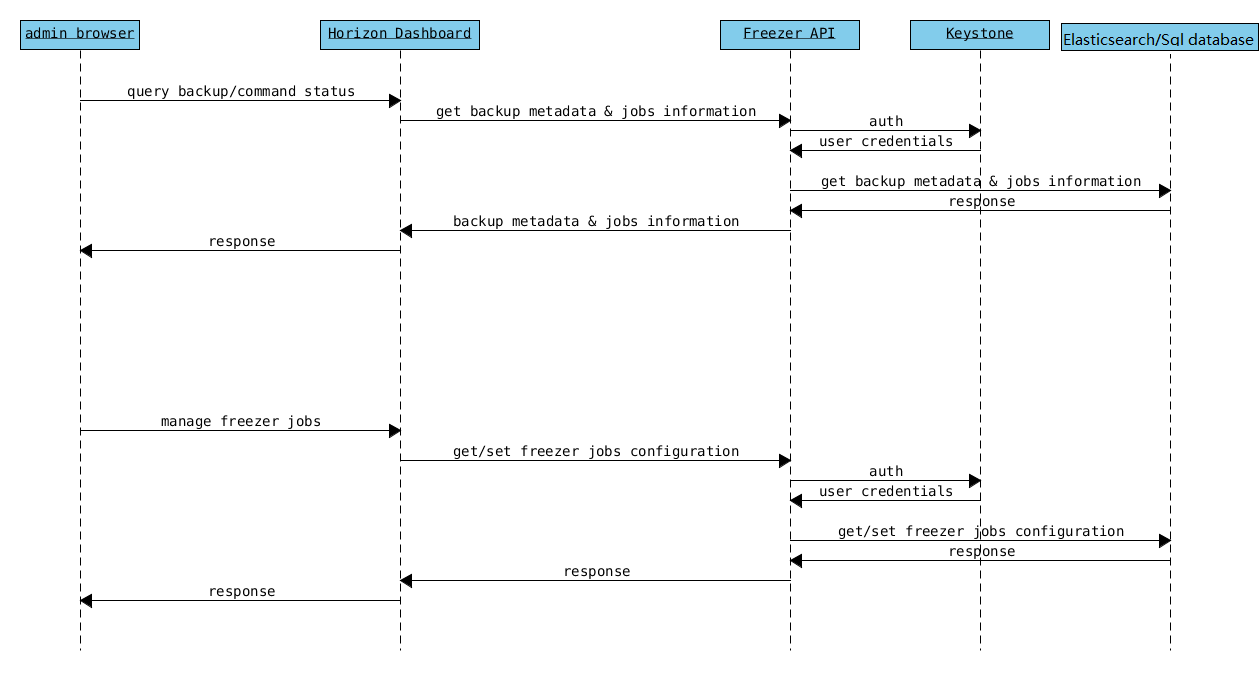
Freezer Web UI |
Web interface integrated with OpenStack Horizon that interacts with the Freezer API to configure backup policies, job schedules, multi-node synchronization, metrics, and restore operations. |
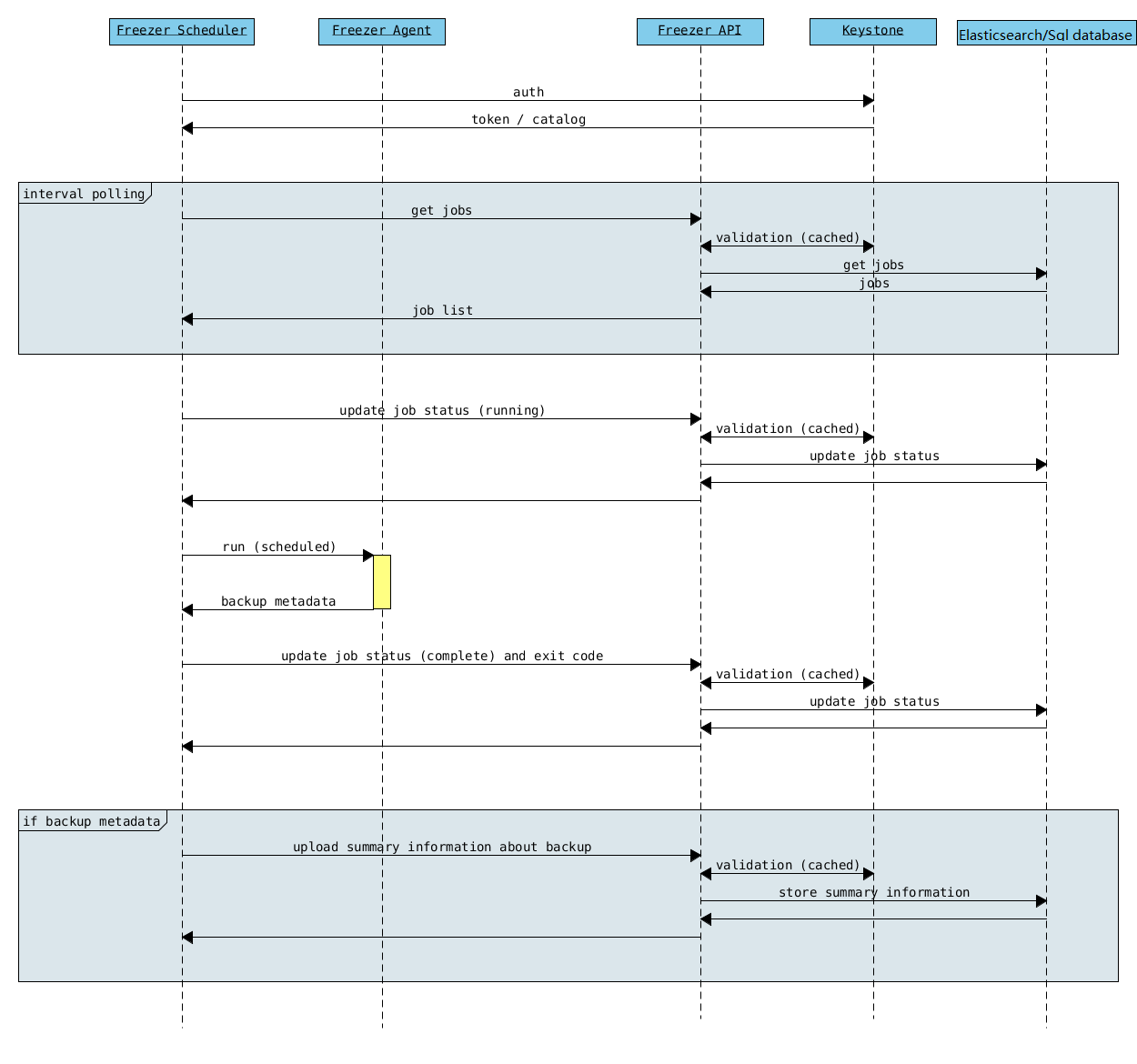
Freezer Scheduler |
Orchestrator daemon. It owns all |
Freezer Agent |
Multiprocessing worker software executing operations
directly against OpenStack services (Cinder, Glance,
Swift, Nova). It is stateless and does not depend on
or communicate with |
Freezer API |
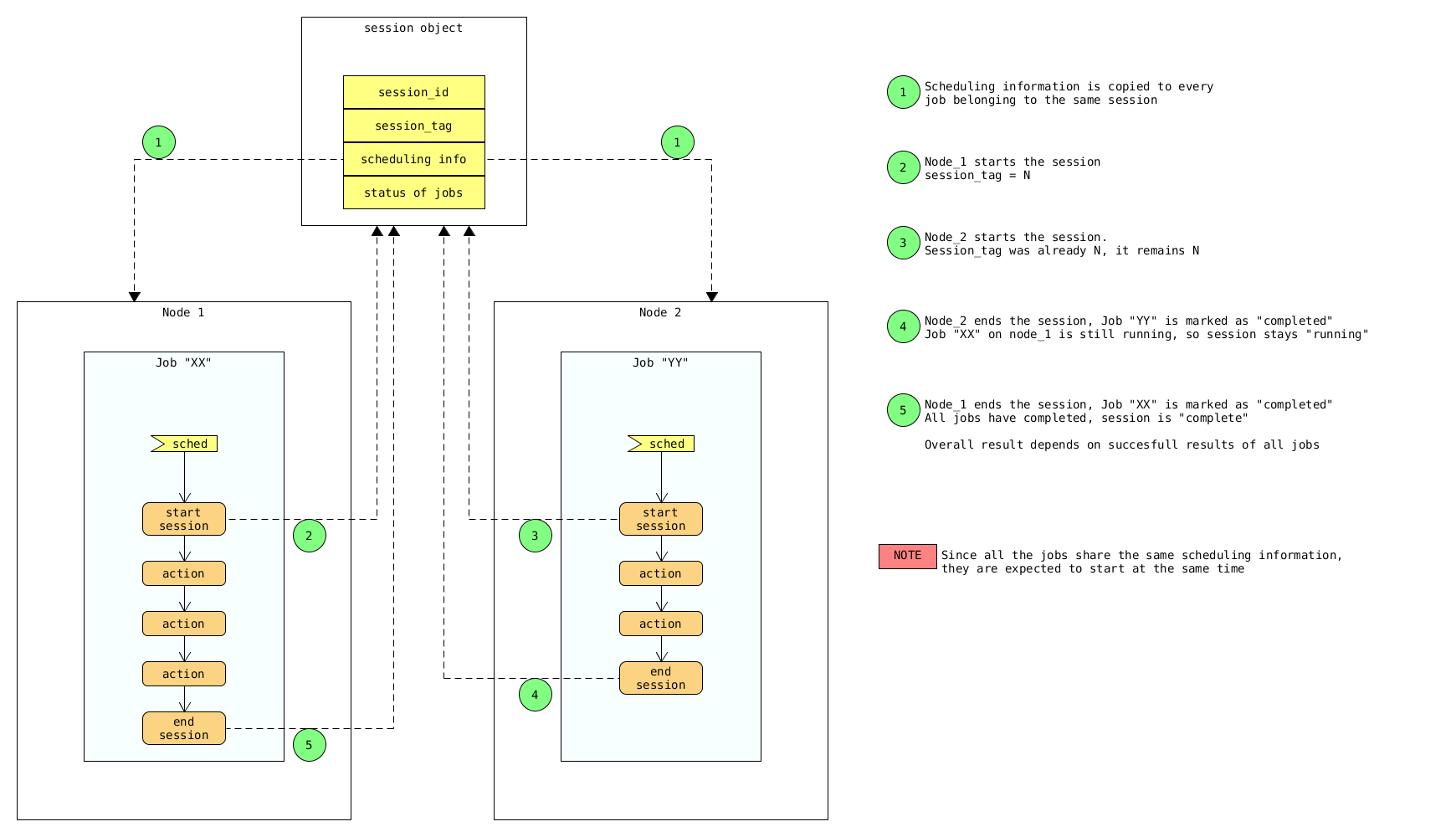
RESTful control plane API providing centralized storage and querying of backup metadata, job definitions, client registrations, and session coordination state. |
Database (DB) |
Backend datastore (Elasticsearch or SQLAlchemy compatible SQL DBs) used by Freezer API to maintain metrics, metadata sessions, and jobs. |
3-Tier Control & Execution Flow
Freezer is designed as a 3-tier architecture with a strict separation of concerns between the API control plane, the scheduler orchestrator, and stateless worker execution agents:
┌─────────────────┐ 1. POST /v2/backups (status: creating) ┌────────────────┐
│                 │ ─────────────────────────────────────> │                │
│                 │ <───────────────────────────────────── │                │
│                 │          2. returns backup_id          │  freezer-api   │
│freezer-scheduler│                                        │  (Central DB   │
│ (Orchestrator)  │  4. PATCH /v2/backups/{id} (available) │    Control)    │
│                 │ ─────────────────────────────────────> │                │
└───────┬─────────┘                                        └────────────────┘
        │
        │ 3. Spawns subprocess:
        │    freezer-agent --config <tmp_file>
        │    (with backup_id in INI)
        ▼
┌────────────────┐        5. Creates Backup               ┌────────────────┐
│ freezer-agent  │ ─────────────────────────────────────> │ OpenStack Svcs │
│(Stateless Wkr) │      metadata={'created_by':'freezer', │(Cinder/Swift/  │
└────────────────┘                'freezer_backup_id': id}│  Glance/Nova)  │
                                                          └────────────────┘
You can check more detailed diagrams of interactions below.
Resource Efficiency & Performance Tuning
Freezer is engineered to minimize CPU, RAM, and I/O consumption on host systems:
Stream Processing & Segmentation
Workload archives generated via GNU Tar or rsync are processed as a continuous stream (compressed via zlib, bzip2, or xz and encrypted via AES-256-CFB).
Streams are partitioned into configurable chunk sizes (set via
--max-seg-size, default 64MB) directly in memory without requiring intermediate local disk space.Segments are uploaded sequentially to Swift or remote storage, followed by a final Manifest object. The manifest links all segments together while ensuring data consistency during uploads.
Memory & Storage Optimization
Small-Memory Hosts: On memory-constrained systems,
--max-seg-sizecan be lowered to reduce peak memory usage.High-Throughput Nodes: On hosts with abundant memory, segment sizes can be increased (up to the 5GB Swift single-object limit) to maximize network and upload throughput.
LVM Snapshot Storage: When performing LVM-backed consistent snapshots (e.g. for MongoDB, MySQL, or filesystem trees), additional temporary disk space equal to the configured snapshot size (
--lvm-snapsize, default 5GB) is allocated in the LVM volume group. Ensure snapshot sizes account for write volume during backup execution to prevent snapshot exhaustion.
How Incremental Backups Work
Freezer supports efficient file-level incremental backups (GNU Tar) as well as block-level differentials (rsync engine).
Workflow
Initialization & Manifest Lookup: When a backup job starts, the Freezer Agent checks the destination storage (Swift/SSH/Local) for existing backup manifests corresponding to the target backup set and hostname.
Metadata Inspection: If prior backups exist, Freezer retrieves the most recent Manifest metadata file. The manifest contains full index headers, timestamp markers, and segment lists from preceding backup runs.
Delta Calculation:
For file-based backups, GNU Tar uses stored timestamp/mtime metadata to identify modified, added, or deleted files since the previous level/incremental baseline.
For block-level backups, rsync block checksum matching is used to transmit only modified byte blocks.
Segmented Upload & Manifest Commit:
Newly generated delta streams are encrypted, compressed, split into memory chunks, and uploaded.
Once all segment uploads complete successfully, a new Manifest object is uploaded, creating an immutable point-in-time recovery point without altering prior backup iterations.
System Visual Diagrams
Service Architecture
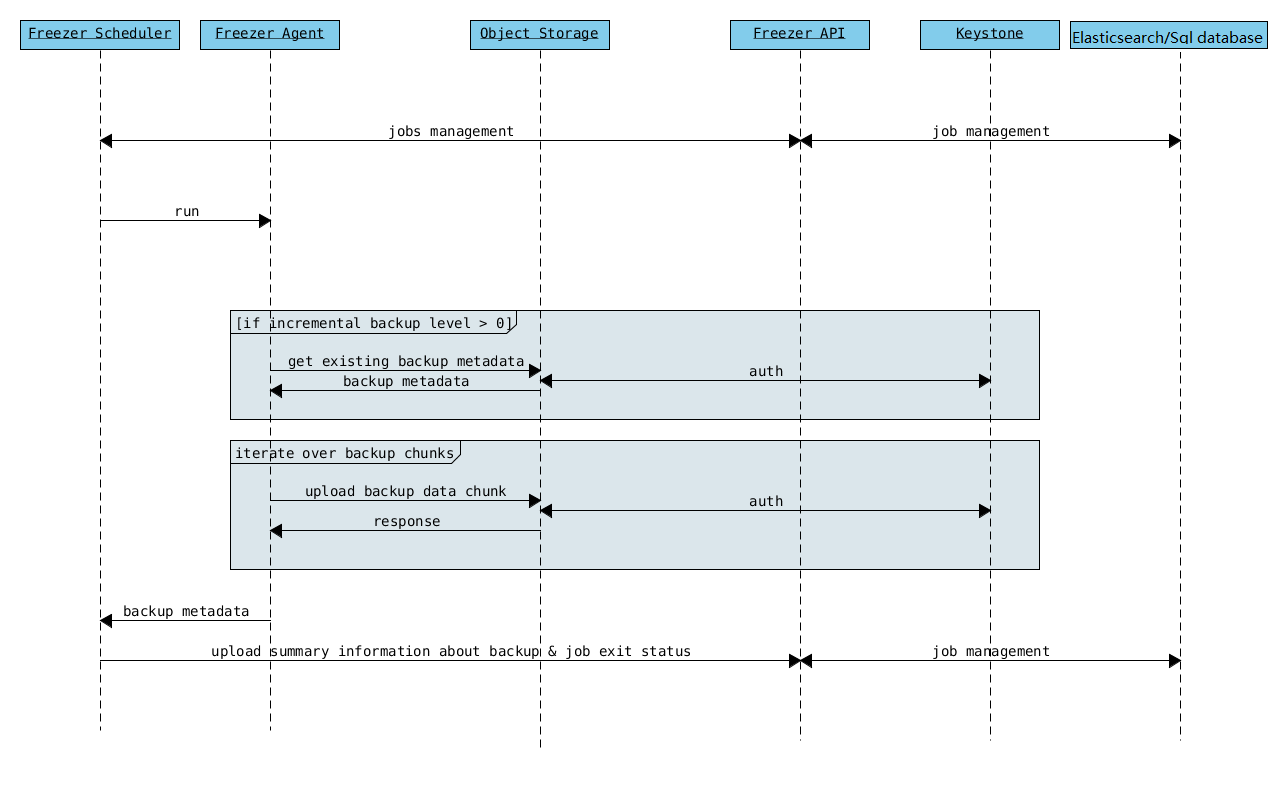
Agent Backup Workflow (with API)
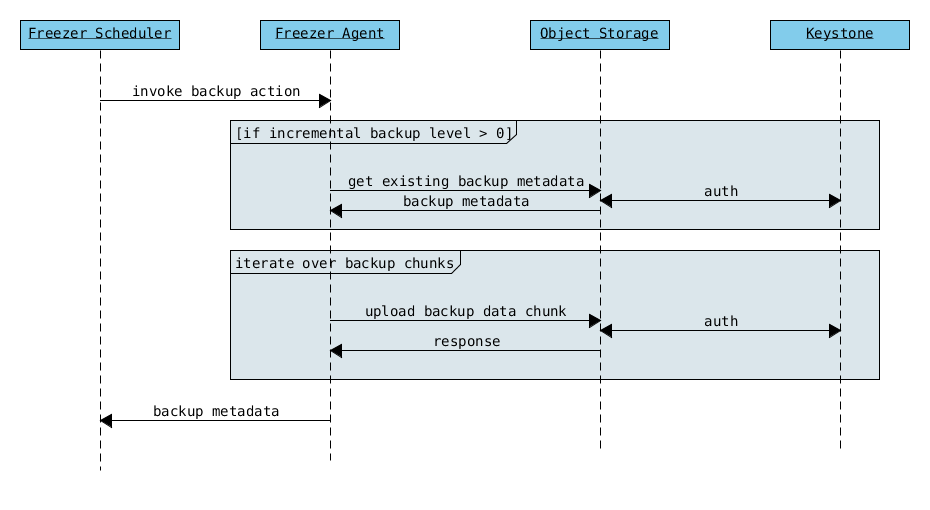
Agent Standalone Backup (without API)
Freezer Scheduler & API Flow
Job Sessions & Multi-Node Synchronization
Horizon Dashboard Overview
High Availability & Scalability