Mistral Architecture
Basic concepts
A few basic concepts that one has to understand before going through the Mistral architecture are given below:
Workflow - consists of tasks (at least one) describing what exact steps should be made during workflow execution.
Task - an activity executed within the workflow definition.
Action - work done when an exact task is triggered.
Mistral components
The Workflow service consists of the following components:
Mistral APIMistral EngineMistral ExecutorMistral Periodic(optional)Mistral Event Engine(optional)Mistral Notifier(optional)
Each component is described in more detail below.
The mistral project also provides the following python libraries:
mistral-dashboardMistral Dashboard is a Horizon (OpenStack dashboard) plugin.
python-mistralclientPython client API and Command Line Interface.
mistral-libA library used by mistral internals.
mistral-extraA collection of extra actions that can be installed to extend mistral standard actions with openstack ones (by default mistral does not ship any OpenStack-related actions).
To work correctly, mistral needs a database (usually mariadb or mysql)
and a queue server (usually rabbitmq).
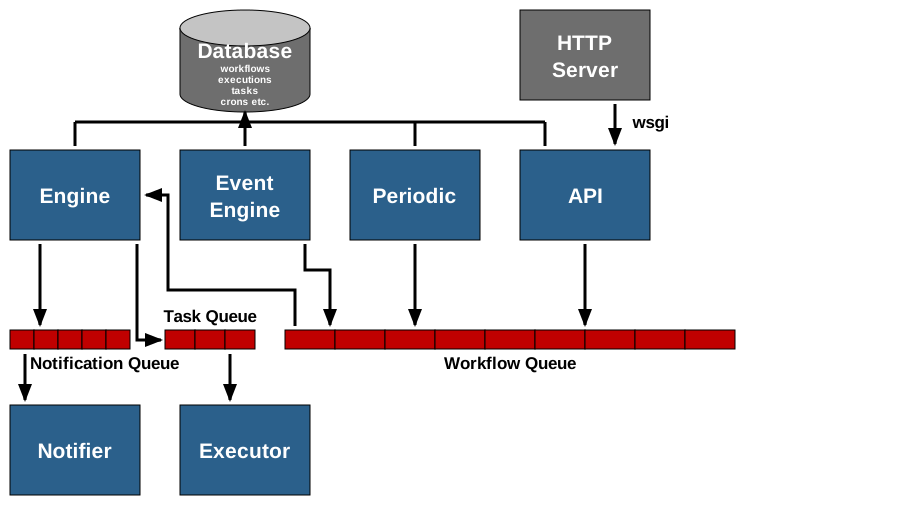
The following diagram illustrates the architecture of mistral:
API server
The API server exposes REST API to operate and monitor the workflow executions.
Engine
The engine picks up the workflows from the workflow queue. It handles the control and dataflow of workflow executions. It also computes which tasks are ready and places them in a task queue. It passes the data from task to task, deals with condition transitions, etc.
The engine also embeds a scheduler that stores and executes delayed calls (e.g. task retries, timeouts and other postponed operations). The scheduler is not a standalone component: it runs inside the engine process and persists its jobs in the database.
Executor
The executor executes task Actions. It picks up the tasks from the queue, run actions, and sends results back to the engine.
Periodic
The periodic component processes cron triggers: when the next execution time
of a cron trigger is reached, it starts the corresponding workflow execution.
By default this processing loop still runs inside the API server, but this
behavior is deprecated: it can run as a dedicated server instead
(mistral-server --server periodic), which will become mandatory for cron
triggers in the next cycle. See
Running cron trigger processing separately for how to deploy it.
Event Engine
The event engine creates workflow executions based on external events: it listens on configured exchanges (e.g. RabbitMQ, HTTP, Kafka) and, when a matching event is consumed, starts the workflows associated with the corresponding event triggers. This service is optional.
Notifier
On workflow and task execution, events are emitted at certain checkpoints such as when a workflow execution is launched or when it is completed. The notifier routes the events to configured publishers. The notifier can either be configured to execute locally on the workflow engine or can be run as a server much like the remote executor server and listens for events. Running the notifier as a remote server ensures the workflow engine quickly unblocks and resumes work. The event publishers are custom plugins which can write the event to a webhook over HTTP, an entry in a log file, a message to Zaqar, and etc. This service is optional.
